A step-by-step guide to foundational pilates exercises you can confidently practise at home — no equipment beyond a mat required.
Starting a pilates workout can feel overwhelming when every video uses unfamiliar terms and moves at a pace that assumes prior experience. If you have heard of the Pilates 100 but have no idea how to perform it safely, you are in the right place. This guide covers ten essential pilates exercises for beginners — explained one at a time, in plain language, with breathing cues, repetitions, and modifications.
All you need is a mat and comfortable clothing. Each exercise below can be completed at home in under two minutes. By the end of this article, you will have a complete 15–20 minute beginner pilates workout you can follow with confidence. These pilates stretches and core exercises build the foundation for every Pilates class you will ever take.
How to Breathe During Pilates
Pilates uses lateral thoracic breathing — inhale through your nose, directing air into the sides and back of your ribcage (imagine your ribs expanding sideways like an accordion). Exhale through your mouth, gently drawing your navel toward your spine. This breathing pattern keeps your deep core muscles engaged while allowing full oxygen exchange.
If this feels unnatural at first, simply focus on not holding your breath. Inhale during the preparation phase of each movement and exhale during the effort phase. With practice, the rhythm becomes automatic. Never strain to breathe — if you feel dizzy, pause and return to normal breathing.
1. The Pilates 100 — The Classic Core Warm-Up
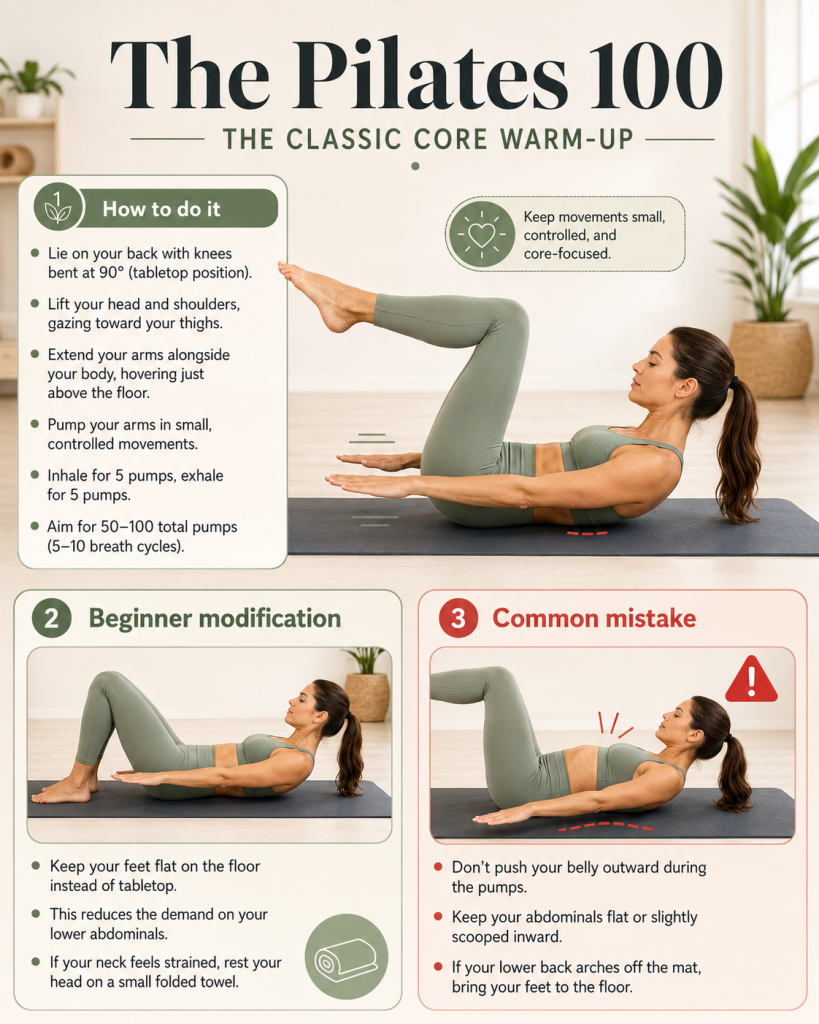
Lie on your back with knees bent at a 90-degree angle (tabletop position). Lift your head and shoulders off the mat, gazing toward your thighs. Extend your arms alongside your body, hovering them a few centimetres off the floor. Pump your arms up and down in small, controlled movements — inhale for 5 pumps, exhale for 5 pumps. Aim for 50–100 total pumps (5–10 breath cycles).
Beginner modification: Keep your feet flat on the floor instead of in tabletop position. This reduces the demand on your lower abdominals while you build strength. If your neck feels strained, rest your head on a small folded towel and pump your arms from that position.
Common mistake: Pushing your belly outward during the pumps. Focus on keeping your abdominals flat or slightly scooped inward. If your lower back arches off the mat, bring your feet to the floor immediately — your core is not yet strong enough for the full version.
2. Pelvic Curl (Bridge)
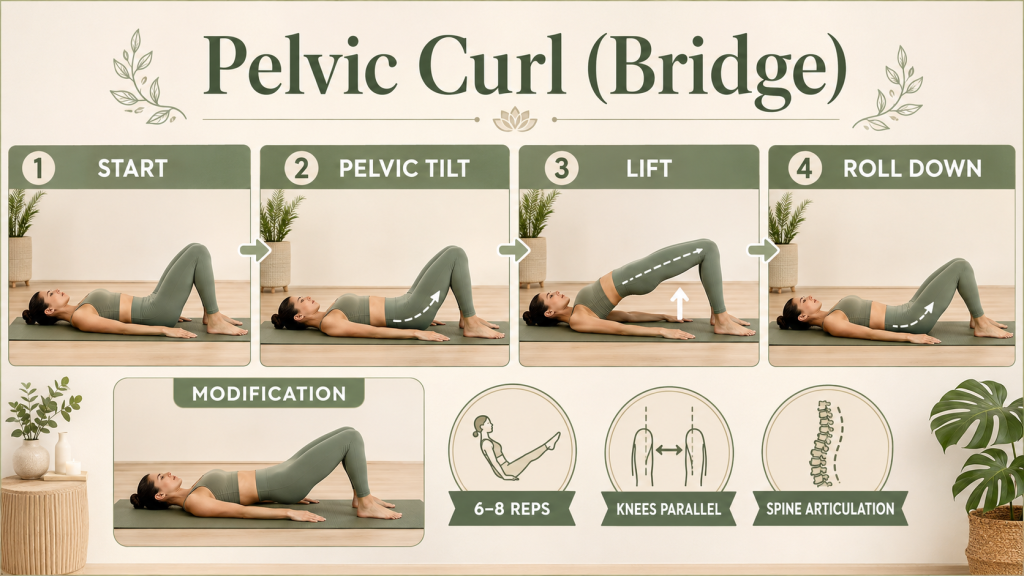
Lie on your back with feet flat on the floor, hip-width apart, arms by your sides. Exhale and gently tilt your pelvis, pressing your lower back into the mat. Continue peeling your spine off the floor one vertebra at a time until your hips are lifted and your body forms a straight line from shoulders to knees. Inhale at the top, then exhale as you roll back down, placing each vertebra sequentially.
Repetitions: 6–8 slow repetitions. Focus on the rolling quality — you should feel each section of your spine articulating rather than lifting as one rigid block. Keep your knees parallel (avoid letting them splay outward).
Modification: If rolling through your spine feels too difficult, simply lift and lower your hips without the sequential articulation. Avoid pushing your hips so high that your lower back overextends — your ribs should stay connected to your abdominals throughout.
3. Chest Lift (Abdominal Curl)
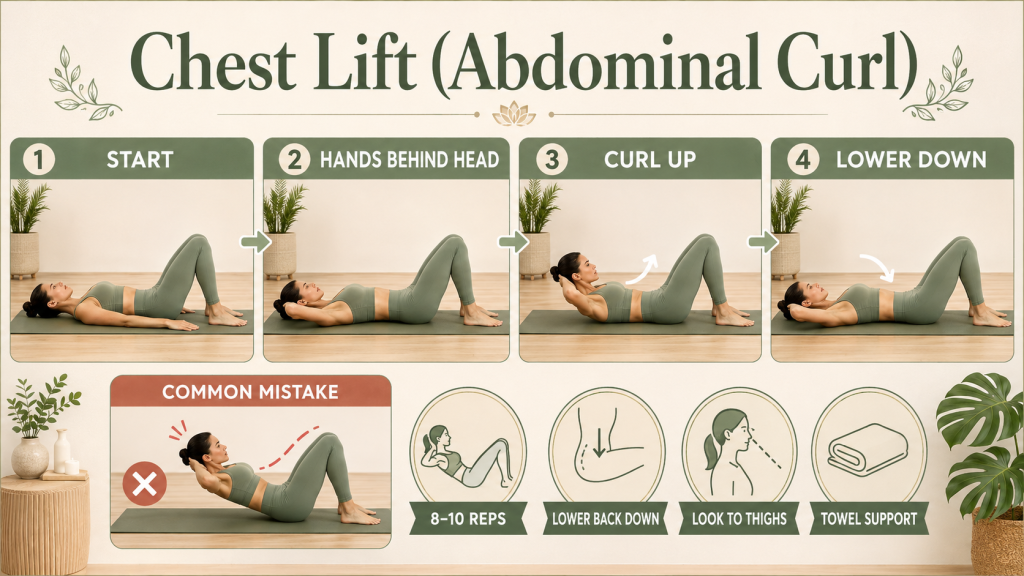
Lie on your back with knees bent, feet flat on the floor. Place your hands behind your head, elbows wide. Exhale and curl your head, neck, and upper shoulders off the mat by engaging your abdominals — imagine sliding your ribcage toward your hips. Inhale and lower back down with control.
Repetitions: 8–10. Keep your lower back in contact with the mat. Your hands support your head — they do not pull it forward. Look toward your thighs, not the ceiling.
Common mistake: Using momentum or yanking the neck. If you feel strain in your neck rather than your abdominals, lower the range of motion or support your head with a towel held in both hands.
4. Single Leg Stretch
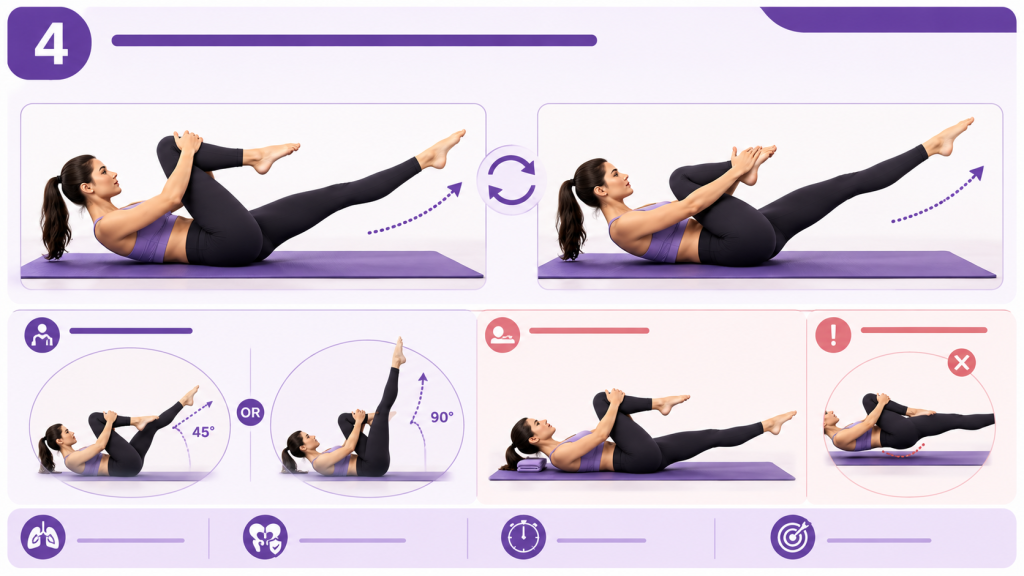
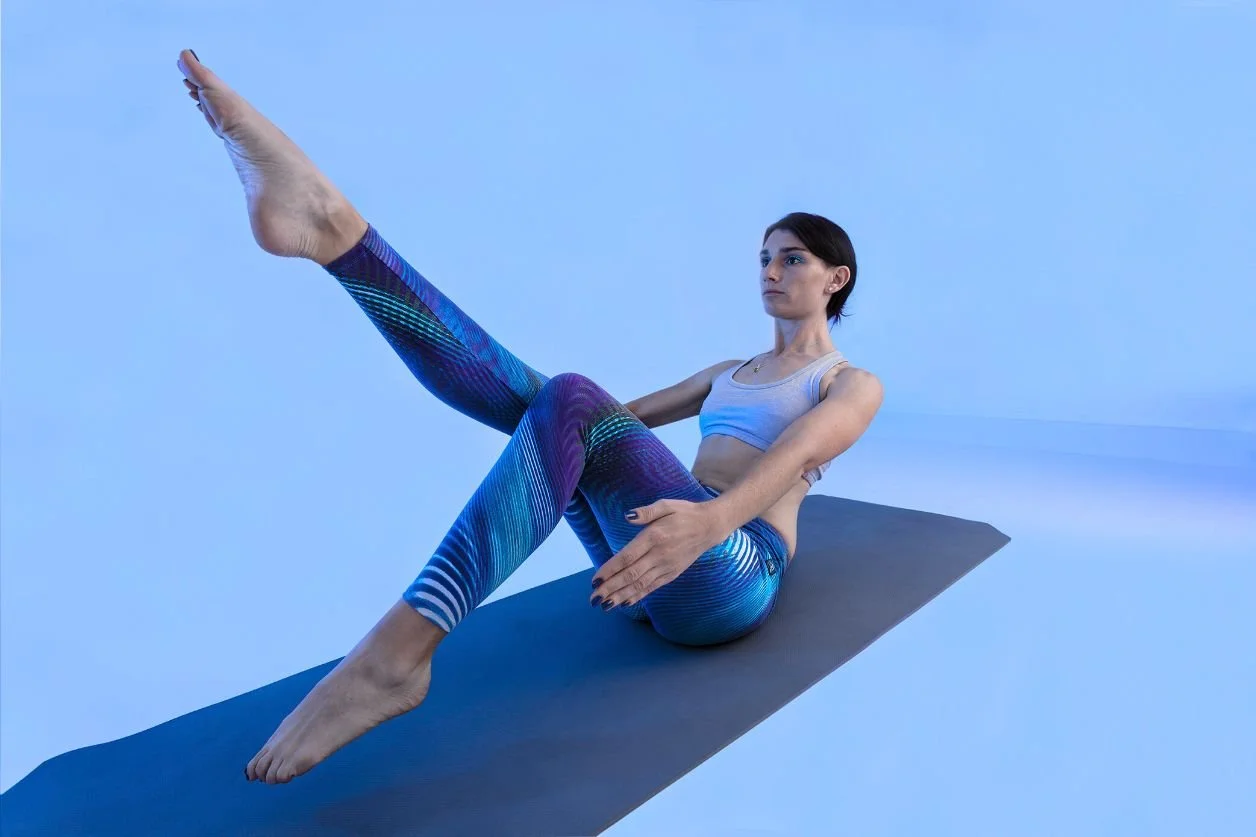
From a chest lift position (head and shoulders off the mat), bring both knees to tabletop. Place your hands on your right shin. Extend your left leg out at a 45-degree angle. Switch legs — draw the left knee in while extending the right leg. Alternate smoothly, coordinating with your breath: exhale as each leg extends.
Repetitions: 8–10 per side (16–20 total switches). Keep your pelvis stable — your lower back should not rock side to side as you switch. Move slowly and deliberately rather than rushing.
Modification: Extend the leg higher toward the ceiling (closer to 90 degrees) to reduce difficulty. If your neck tires, rest your head down and continue the leg movements. Stop if your lower back lifts off the mat.
5. Shoulder Bridge
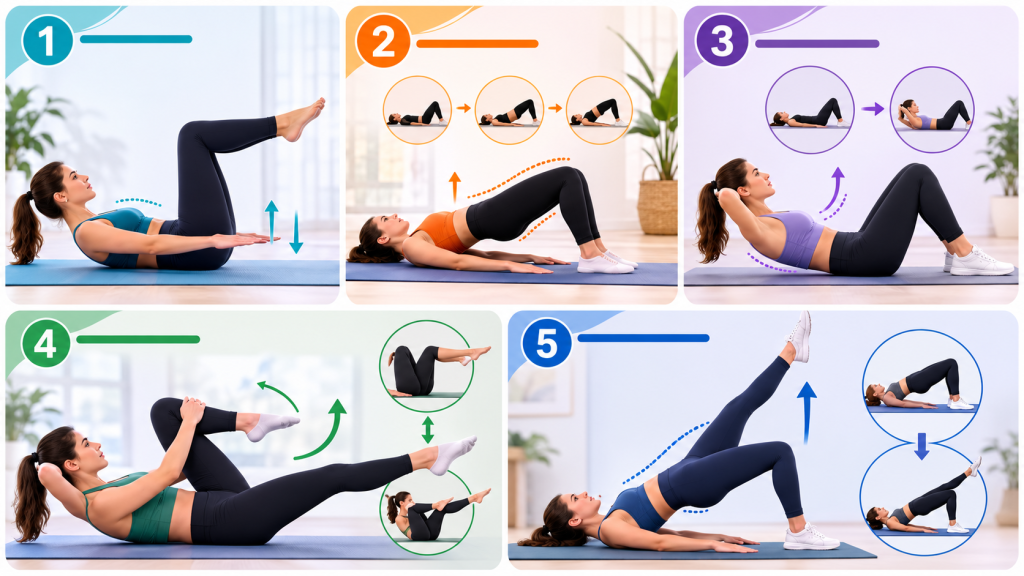
Start in your pelvic curl position — hips lifted, body in a straight line from shoulders to knees. Keeping your hips level, extend one leg toward the ceiling (or straight forward at knee height for an easier option). Lower and lift the extended leg 3–5 times without dropping your hips. Place the foot back down and repeat on the other side.
Repetitions: 3–5 leg lifts per side. The challenge here is maintaining level hips — if one hip drops when you lift a leg, return to the basic pelvic curl until you build more stability.
Safety note: If you feel cramping in your hamstrings, lower your hips slightly and press firmly through the standing foot. Keep your weight distributed evenly across your shoulders — never press into your neck.
6. Spine Stretch Forward
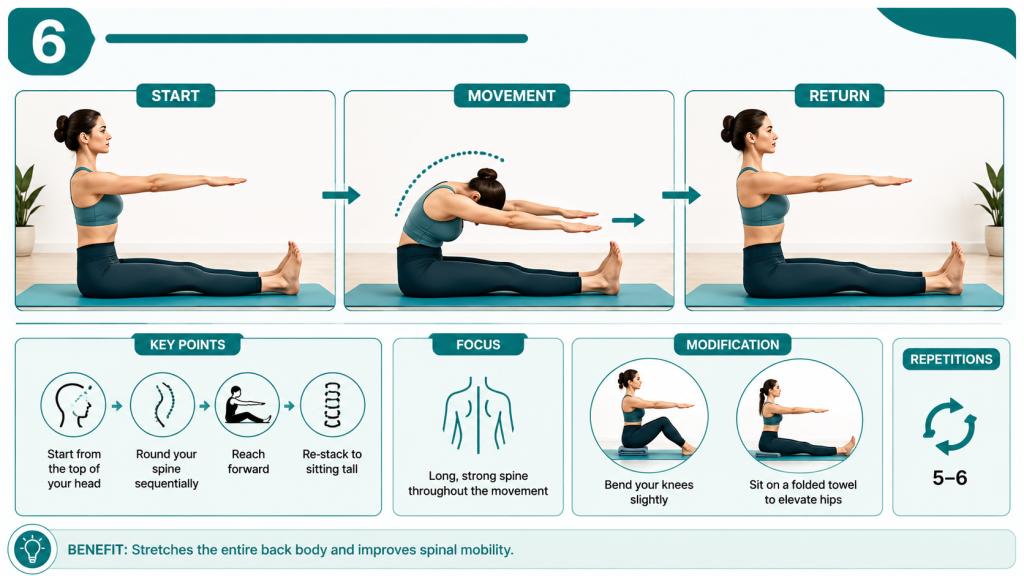
Sit tall with legs extended in front of you, slightly wider than hip-width, feet flexed. Reach your arms forward at shoulder height. Exhale and round forward, starting from the top of your head — imagine curving over a large beach ball. Reach past your toes while keeping your sit bones anchored. Inhale and re-stack your spine to sitting tall.
Repetitions: 5–6. This is one of the most effective pilates stretches for the entire back body. Focus on the sequential rounding rather than simply folding forward from the hips.
Modification: If you cannot sit tall with straight legs, bend your knees slightly or sit on a folded towel to elevate your hips. Tight hamstrings will limit your forward reach — that is completely normal for beginners.
7. Swimming
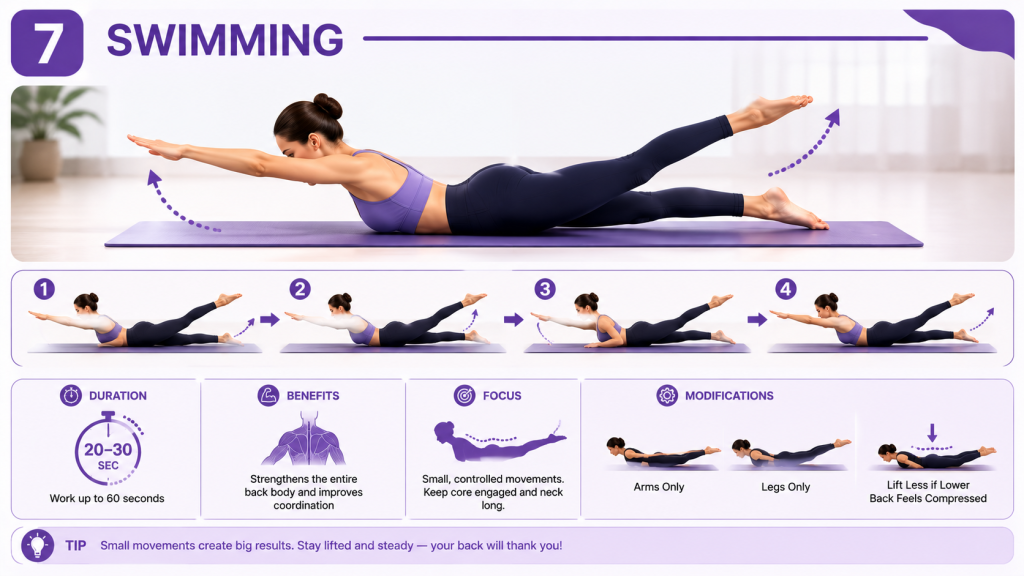
Lie face down with arms extended overhead and legs straight behind you. Lift your chest, arms, and legs slightly off the mat. Flutter opposite arm and leg upward in small alternating movements — right arm with left leg, then switch. Breathe in for 5 counts and out for 5 counts while fluttering continuously.
Duration: 20–30 seconds (work up to 60 seconds). This strengthens the entire back body and improves coordination. Keep the movements small and controlled — bigger is not better here.
Modification: Lift only your arms (keeping legs on the mat) or only your legs (keeping arms on the mat) until you build enough back strength for the full exercise. If you feel lower back compression, reduce how high you lift.
8. Seated Spinal Twist
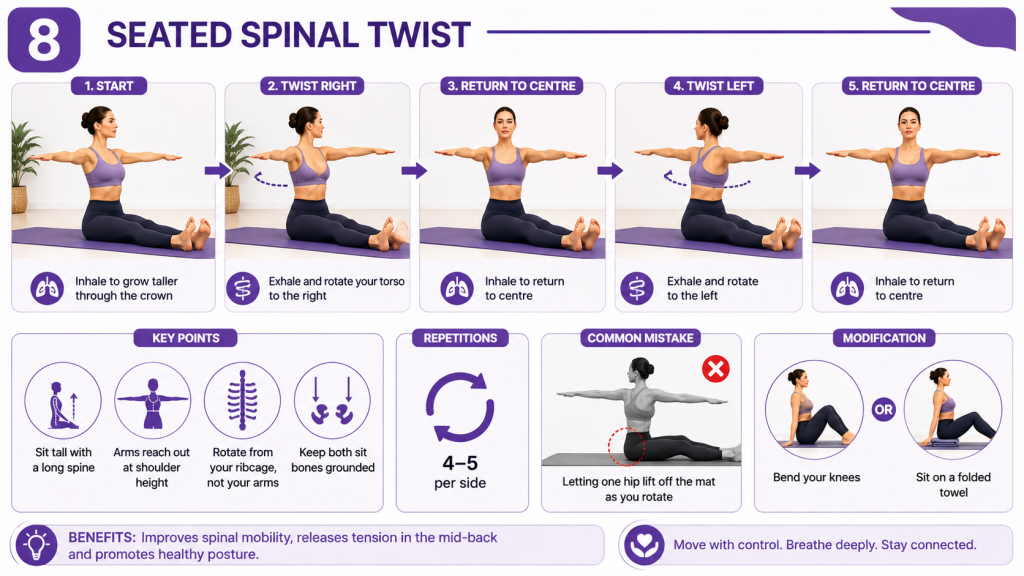
Sit tall with legs extended, arms reaching out to the sides at shoulder height. Inhale to grow taller through the crown of your head. Exhale and rotate your torso to the right — imagine wringing out your spine like a towel. Inhale to return to centre, then exhale to rotate left. Keep both sit bones grounded throughout.
Repetitions: 4–5 per side. This is a wonderful pilates stretch for spinal mobility and releasing tension in the mid-back. Rotation should come from your ribcage, not from swinging your arms.
Common mistake: Letting one hip lift off the mat as you rotate. If your hamstrings are tight and prevent you from sitting upright, bend your knees or sit on a folded towel.
9. Side Leg Lift Series
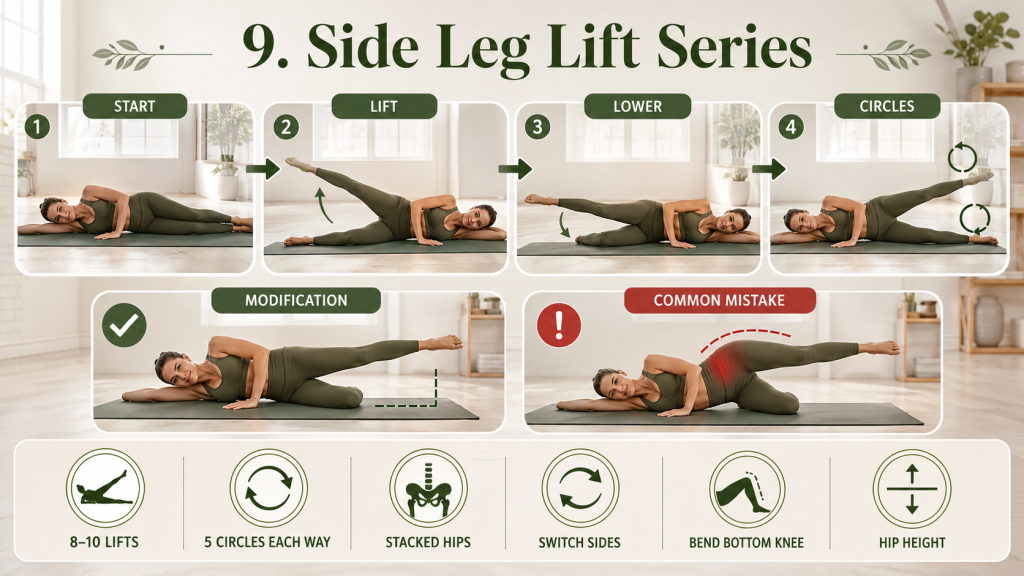
Lie on your side in a straight line — bottom arm extended under your head, top hand on the mat in front of your chest for balance. Keeping your hips stacked, lift your top leg to hip height and lower it back down with control. After your set, add small circles in each direction.
Repetitions: 8–10 lifts plus 5 circles each direction, then switch sides. This targets the outer hip and improves pelvic stability — essential for good posture and walking mechanics.
Modification: Bend your bottom knee for more stability. Avoid rolling your hips backward — a common tendency that reduces the exercise’s effectiveness. Your top hip should remain directly above your bottom hip throughout.
10. Cat-Cow Stretch (Spinal Flexion and Extension)
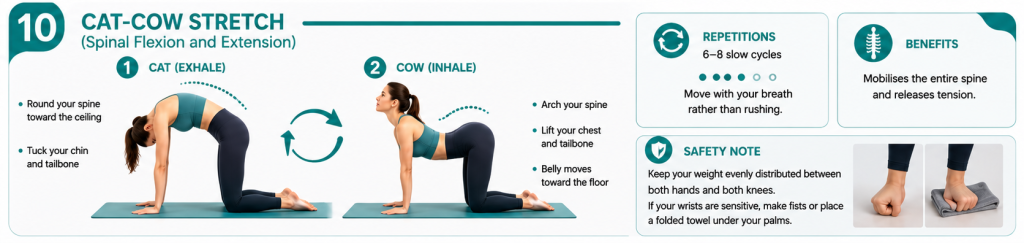
Come onto all fours — hands under shoulders, knees under hips. Exhale and round your spine toward the ceiling, tucking your chin and tailbone (cat). Inhale and arch your spine, lifting your chest and tailbone toward the ceiling while your belly moves toward the floor (cow). Flow between these two positions smoothly.
Repetitions: 6–8 slow cycles. This is an ideal way to begin or finish any pilates workout — it mobilises the entire spine and releases tension. Move with your breath rather than rushing.
Safety note: Keep your weight evenly distributed between both hands and both knees. If your wrists are sensitive, make fists or place a folded towel under your palms for cushioning.
Your Complete 15-Minute Beginner Pilates Workout
Perform the exercises in the order listed above for a balanced full-body pilates workout. Start with Cat-Cow to warm up your spine (1 minute), move through the Pilates 100 and core exercises (8 minutes), then finish with Spine Stretch and Seated Twist (3 minutes). Rest 15–30 seconds between exercises as needed. The full sequence takes approximately 15–20 minutes.
Aim to practise this routine 2–3 times per week. Consistency matters more than duration — short regular sessions build strength and body awareness faster than occasional long workouts. As exercises become easier, increase repetitions before moving to more advanced variations.
Frequently Asked Questions
Can beginners do Pilates at home?
Absolutely. Every exercise in this guide requires only a mat and enough floor space to lie down with arms extended. Pilates was designed to be practised anywhere. Many people build confidence at home before attending a studio class.
How often should a beginner practise Pilates?
Two to three sessions per week is ideal for beginners. This gives your body time to recover and adapt. Even 10–15 minutes per session delivers meaningful improvements in core control, posture, and flexibility within a few weeks.
What equipment do I need to start?
A standard exercise mat (6–8mm thick) and comfortable clothing that allows movement. No shoes required — Pilates is practised barefoot or in non-slip socks. You do not need a reformer, resistance bands, or any other equipment for these foundational exercises.
What is the Pilates 100 and why is it important?
The Pilates 100 is a core endurance exercise that warms up the body and builds abdominal stamina. You pump your arms 100 times while holding a chest lift position. It teaches breath coordination and engages the deep stabilising muscles of the torso — making it a foundation for every other Pilates movement.
Which pilates stretches improve flexibility fastest?
Spine Stretch Forward, Seated Spinal Twist, and Cat-Cow are the most effective pilates stretches for beginners. They target the spine, hamstrings, and shoulders — areas where most people carry stiffness. Practised regularly, you should notice improved range of motion within 2–3 weeks.